Mastering UK Medicine Applications: UCAT, Personal Statement & Interviews
16 September 202635 minFor UK applicants
Olivia teaches this live every Saturday, with small-group practice and mentor feedback. See the interview programme
How your UCAT score shapes your choices, what goes in the personal statement, and how MMI and panel interviews work.
Olivia B, Medical student
The short version
- Let your UCAT score decide where you apply: universities set cut-offs, and an SJT Band 4 leads to automatic rejection at many of them.
- If your UCAT score is low, apply to universities that put more weight on the personal statement, such as Keele and Sunderland.
- Write your personal statement yourself and keep every claim true, including the books you say you have read; AI detectors are strict.
- An MMI is a circuit of 10 stations of 7 to 8 minutes each and can last up to 2 hours; a panel interview asks about you, your statement and your motivation, at 2 to 3 minutes per question.
- Structure answers around the problem you faced, how you overcame it and the skills you used, then link the answer explicitly back to medicine or dentistry.
- Start practising out loud in December, before any invitation arrives; continuous spoken practice and timed mocks are how you stop freezing on the day.
Where you are in the application cycle
The cycle runs in four stages. Your UCAT score shapes where you apply, the personal statement follows, then interviews, and any offer you receive depends on your A-Level results.
UCAT
NowFinishing now
Your score shapes which universities you choose.
Personal statement
After the UCAT
Three questions: why this course, your qualifications, and your experience outside education.
Interviews
December to March
Held mainly in this window, after personal statements are submitted.
A-Level results
After an offer
An offer is conditional on meeting its grades, for example AAA.
Using your UCAT score to choose universities
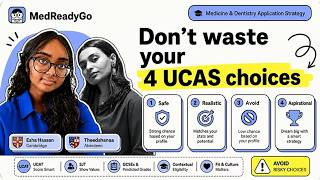
Universities set UCAT score cut-offs, so your score should decide where you apply. You have five choices: four for medicine or dentistry and one for a non-medical course.
Before you commit a choice, check three things for each university.
- Its UCAT cut-off.
- Its GCSE points system.
- Its A-Level subject requirements. Chemistry is required everywhere.
If your UCAT score is low, apply to universities that put more weight on the personal statement, such as Keele and Sunderland.
What goes in your personal statement
The personal statement is made up of three structured questions. Between them they should cover your journey towards medicine, your work experience and your volunteering.
- Why you want to study the course.
- How your qualifications and studies have prepared you.
- What you have done outside education: extra-curricular activities, work experience and volunteering.
Make sure it also covers these:
- Non-academic achievements.
- Your knowledge of the NHS and its core values.
- Your third A-Level subject.
Do
- Write it yourself.
- Be completely truthful about the books you have read.
- Be completely truthful about the experience you have had.
Don't
- Use AI tools to write it. The detectors used are strict.
- Refer to any specific university.
- Share political views.
MMI and panel interviews
Interviews run mainly from December to March. The two formats work very differently, so know which one each of your universities uses and what it tests.
| MMI | Panel interview | |
|---|---|---|
| Format | A circuit of 10 different stations, each with its own examiner | A traditional board-style interview with several interviewers |
| Total length | Up to 2 hours | Usually around 10 minutes |
| Time per question | Typically 7 to 8 minutes per station | Typically 2 to 3 minutes per question |
| What it covers | Ethics, NHS knowledge, role-play scenarios and situational judgement | Your background, your personal statement and your motivation for medicine |
How to prepare
Start practising in December. Do not wait for an official invitation before you begin.
Structure your answers with the STAR method or a structured reflection, and link every answer explicitly back to medicine or dentistry. A structured reflection runs in this order:
- The problem you faced.
- How you overcame it.
- The skills you used.
- How that links back to medicine or dentistry.
Have thorough answers ready for the standard questions:
- Why medicine?
- Why this university?
- How important is work-life balance?
Questions from the session
Asked live by applicants on the call, rewritten for reference.
How can an international applicant work out which UK medical schools suit them?
Go to virtual open days. They show you how each university teaches, and this varies: some courses are lecture-heavy, others are more clinical and hands-on.
Should an international applicant bring their home country's healthcare system into interview answers?
Yes. Comparing the NHS with the healthcare system you know from home is a strong point to make at interview.
Are international applicants assessed on equal terms with UK applicants?
Yes. Equal opportunity (EDI) policies mean international students are evaluated on an equal footing.
What are unusual MMI stations, such as interpreting a graph or doing a manual task, actually testing?
They test your logical reasoning, communication skills and decision-making, not whether you know an exact answer.