Wondering How the UK Medicine Application Timeline Works?
Applying to study medicine in the UK can feel overwhelming. This step-by-step timeline covers everything from UCAT and GAMSAT prep to UCAS deadlines, interviews, and offers which will help you plan, stay organized, and feel confident.
Hey future doctors! 👋
If you’re reading this, you’re probably thinking: “Okay, I want to study medicine, but I have no idea where to start!” Don’t worry—you’re not alone. The medical application process can feel super overwhelming, with tests, personal statements, references, and interviews all happening at different times.
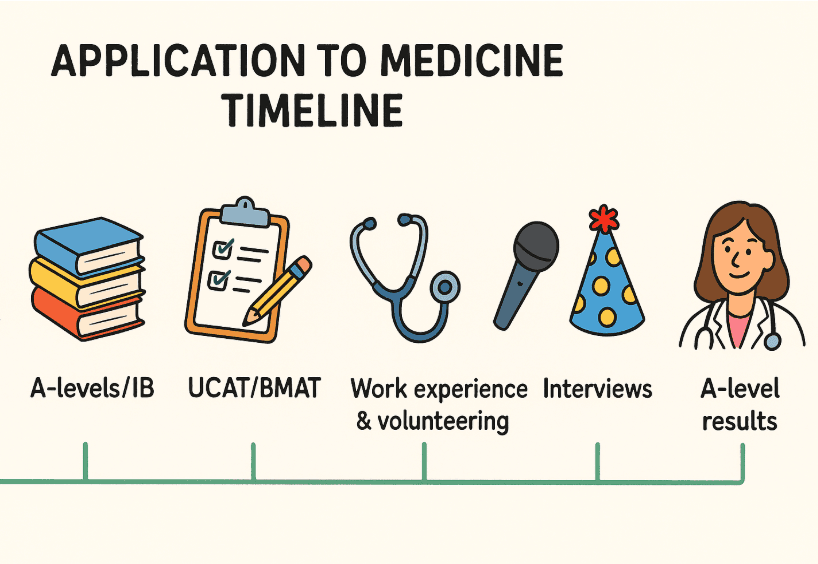
Here’s a friendly guide to the general UK medicine admissions timeline, including graduate-entry considerations like the GAMSAT, so you know what to do and when.
🗓 Step 1: Year 12 / Year 13 (or equivalent) – Start Preparing
Timing: 12–18 months before applying
What to focus on:
Academic grades: Medicine is competitive, so aim for strong grades in sciences (Biology, Chemistry, Maths, Physics).
Entrance exams: Most UK medical schools require UCAT for undergraduate applicants. Graduate-entry medicine requires GAMSAT.
Work experience: Hospitals, GP surgeries, dental clinics, volunteering, or charity work. Online placements can also count.
Research universities: Look into course length, teaching style, and admissions requirements.
Pro tip: Keep a work experience log. Reflect on what you learned—it’s invaluable for your personal statement.
📝 Step 2: UCAS Application Opens
Timing: Early September (Year 13 or graduate-entry timeline)
UCAS is the system you use to apply to medicine courses.
You can apply to up to 4 medical courses (or 5 if applying to Oxbridge).
Prepare your personal statement, highlighting:
Motivation for medicine
Work experience reflections
Relevant skills (teamwork, empathy, communication)
Pro tip: Start your personal statement early and get feedback from teachers, mentors, or graduate advisors. Multiple drafts make a huge difference.
🧪 Step 3: Take Entrance Exams
Timing: July–October (for UCAT), January–April (for GAMSAT)
UCAT is required for most undergraduate medicine courses. Practice consistently using question banks and timed mock exams.
GAMSAT is required for graduate-entry medicine. It tests reasoning, written communication, and science knowledge. Start revising several months in advance and practice under timed conditions.
Pro tip: Daily or regular practice—even 20–30 minutes—can improve performance significantly. For GAMSAT, focus on critical thinking, essay writing, and interpreting scientific data.
📬 Step 4: Submit UCAS
Timing: Mid-October (medicine deadline for undergraduates), slightly later for some graduate courses
Medicine has an earlier deadline than most courses (usually 15th October for undergraduates).
Make sure:
Personal statement is polished
References are ready
UCAS form is double-checked
Pro tip: Missing the deadline can delay your application by a year—plan ahead!
📩 Step 5: Interview Invitations
Timing: October–February (undergraduate), March–June (graduate-entry)
Universities invite applicants for interviews based on academic record, personal statement, UCAT/GAMSAT performance.
Interviews can be MMI (Multiple Mini Interviews) or panel interviews.
Start preparing:
Practice ethical scenarios and problem-solving stations
Reflect on work experience and personal motivation
Research each university’s interview style
Pro tip: Mock interviews, AI-based platforms, or practice with friends/mentors can help with timing, confidence, and communication.
🏥 Step 6: Attend Interviews
Timing: November–March (UG), April–June (Graduate)
MMI stations usually last 5–10 minutes; panel interviews 20–30 minutes.
Be professional, concise, and reflective.
Focus on communication, reasoning, ethical awareness, and empathy, not just textbook knowledge.
Pro tip: Dress professionally, be punctual, and treat each station like a real-life scenario.
📄 Step 7: Offers
Timing: January–July
Universities send offers based on predicted grades (UG) or academic/entrance exam performance (GAMSAT/graduate).
Offers can be conditional (achieving exam results) or unconditional.
Pro tip: Keep track of deadlines for accepting offers via UCAS.
🎯 Step 8: Exam Results
Timing: August
Conditional offers depend on A-levels, IB, or equivalent results.
Graduate-entry applicants must meet degree requirements and GAMSAT scores.
If you meet requirements, your place is confirmed; if not, UCAS Clearing may help.
Pro tip: Stay calm—universities understand that predicted grades sometimes differ from final results.
💡 Extra Tips for Success
Plan early: Give yourself at least a year of prep.
Organize deadlines: UCAS, UCAT, GAMSAT, interviews, and offers.
Reflect on experiences: Notes from volunteering/shadowing are gold for personal statements and interviews.
Practice interviews: Mock MMIs and panels improve timing, confidence, and communication.
Stay healthy: Sleep, exercise, and breaks improve focus and performance.
✅ Bottom Line
The medicine application process might seem confusing, but if you plan ahead, stay organized, and prepare consistently, it becomes manageable:
Start researching and preparing early
Focus on academic requirements and entrance exams (UCAT/GAMSAT)
Gain work experience and reflect on it
Prepare a strong personal statement
Practice for interviews
Track deadlines and offers
Follow this timeline, and you’ll feel confident navigating your medical school application like a pro! 💪