Raynaud’s Phenomenon: Understanding Causes, Symptoms & Types
Raynaud’s Phenomenon causes sudden numbness and colour changes in fingers and toes. Discover the difference between primary and secondary types, what triggers attacks, and how to manage this condition effectively.
Author: Colonia Benny Year 13 Student - Head Girl of St. Philomenas 2025
An individual has a wide range of regulatory mechanisms that maintain the conditions within to ensure that all tissue functions are fully optimised and to enable the body to withstand the daily activities of a human's bustling life. Additionally, individuals have defence mechanisms that provide protection and respond to unwanted microorganisms entering the body (physical and chemical barriers, non-specific innate responses, and specific adaptive responses). However, an individual with Raynaud’s Phenomenon has an additional response to the surrounding environment - an uncontrollable response so sudden that some may say it almost feels “second nature”.
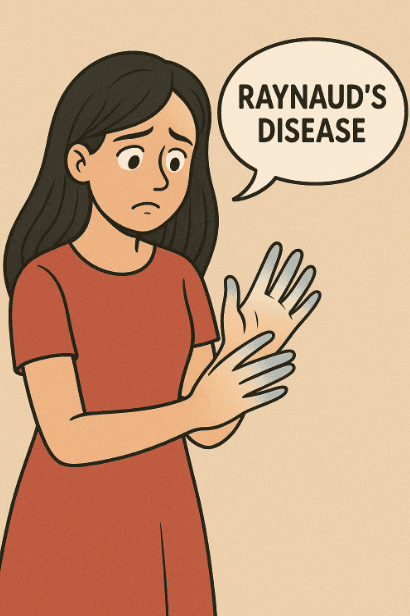
Raynaud’s Phenomenon is an episodic, reversible vasospasm of the peripheral arteries, that causes some of the areas on the body - such as the fingers and toes - to experience a cold and numbing sensation in response to the surrounding cold temperatures; this condition is commonly associated with triggers made by the dynamic temperature changes in the individual’s environment but, can also be anxiety and stress-induced.
The prevalence rate of Raynaud’s Phenomenon varies depending on the countries and the environment each individual is exposed to - one large US cohort study (4182 people) found symptoms in 9.6% of women and 8.1% of men yet, smaller cohort studies in Spain have estimated the prevalence of Raynaud's phenomenon to be 3.7% to 4.0%. However, what causes this significant difference in prevalence rates in different countries and does that affect the ultimate cause and severity of the condition?
Causes of Raynaud’s Phenomenon:
Scientists are still unsure as to why Raynaud’s phenomenon develops in certain people, but they have acquired an understanding of how attacks and flare-ups happen.
When a person is exposed to cold temperatures, the body tries to counteract the ambient temperature change by slowing down the loss of heat to maintain the body’s temperature and conditions. To ensure that the body’s heat is preserved, blood vessels in the surface layer of the skin constrict (narrow), moving blood from vessels near the surface to those deeper in the body. Areas in the body - such as the fingers, toes, ears and nose - may exhibit discolouration (it may turn white due to the lack of blood flow or blue due to the lack of oxygen). Additionally, individuals may experience a numbing and tingling sensation that provides stiffness or a lack of movement within the areas experiencing an attack. Such attacks (or flare-ups, depending on the triggers) can last up to long periods, from several minutes up to over an hour, yet, in worst-case scenarios, include attacks lasting over several hours.
However, scientists have discovered that the ultimate cause of Raynaud’s Phenomenon can essentially depend on the type an individual has been diagnosed with.
There are two types of Raynaud’s phenomenon:
Primary Raynaud's phenomenon has no definite cause but has certain factors that can lead the individual to have the condition - it is the more common form of the condition.
Secondary Raynaud's phenomenon is associated with underlying conditions, such as a rheumatic disease like lupus or scleroderma.
Factors such as exposure to cold temperatures or certain chemicals may also be linked to this form.
The secondary form is less common but typically more serious than the primary form due to damage that occurs to the blood vessels.
Primary VS Secondary Raynaud’s Phenomenon:
Both Primary and Secondary Raynaud’s include the basis of the peripheral arteries constricting in certain areas to maintain the body’s internal temperature and conditions (when being exposed to an ambient temperature change). In medical terms, it is a reversible vasospasm of arteries, especially of the digits, with pallor, redness, extremity pain and/or cyanosis. However, the breakdown of both and the severity of Primary and Secondary Raynaud's can be extremely different. Raynaud's phenomenon can be either primary (idiopathic) or secondary to several underlying conditions, and the pathogenesis and pathophysiology ( a branch of study concerning disordered physiological processes that cause, result from, or are otherwise associated with a disease or injury) vary between these conditions
Primary Raynaud’s Phenomenon has no association with any underlying causes or diseases the individual may have - this means that a correlation (as well as cause and effect relationship) has not been established.
However, Secondary Raynaud’s Phenomenon is associated with connective tissue disorders such as systemic sclerosis, systemic lupus erythematosus, and mixed connective tissue disease.
Overall, Raynaud’s Phenomenon is quite a common (yet extremely fascinating) condition - some individuals diagnosed with Raynaud's may have been genetically predisposed to the condition; however, healthcare professionals are confused about how some individuals randomly start experiencing the symptoms and their triggers. Even though there are no definite treatments to completely cure Raynaud's, there are many treatment plans that are in place for individuals to manage the symptoms and to avoid triggering a flare-up, causing them to experience an uncomfortable sensation for a period of time.
Bibliography:
What are the three lines of defense -
https://www.news-medical.net/health/What-are-the-Three-Lines-of-Defense.aspx [Accessed 20th February 2025]
Raynaud's phenomenon (primary) - https://pmc.ncbi.nlm.nih.gov/articles/PMC3794700/ [Accessed 20th February 2025]
A. L. Herrick, Pathogenesis of Raynaud's phenomenon, Rheumatology, Volume 44, Issue 5, May 2005, Pages 587–596, https://doi.org/10.1093/rheumatology/keh552