US Medical School Interviews: MMI vs Traditional (Complete 2025-2026 Guide)
Learn the difference between MMI and traditional medical school interviews. Complete prep guide with station types, questions, and proven strategies.
Reading time: 10 minutes
You just got an interview invite. You're excited. You're terrified.
When will this happen? Check AMCAS timeline
Then you see the email: "Your interview will be in MMI format."
What the heck is MMI?
(If you're applying to US medical schools, you need to know this.)
The Two Main Formats
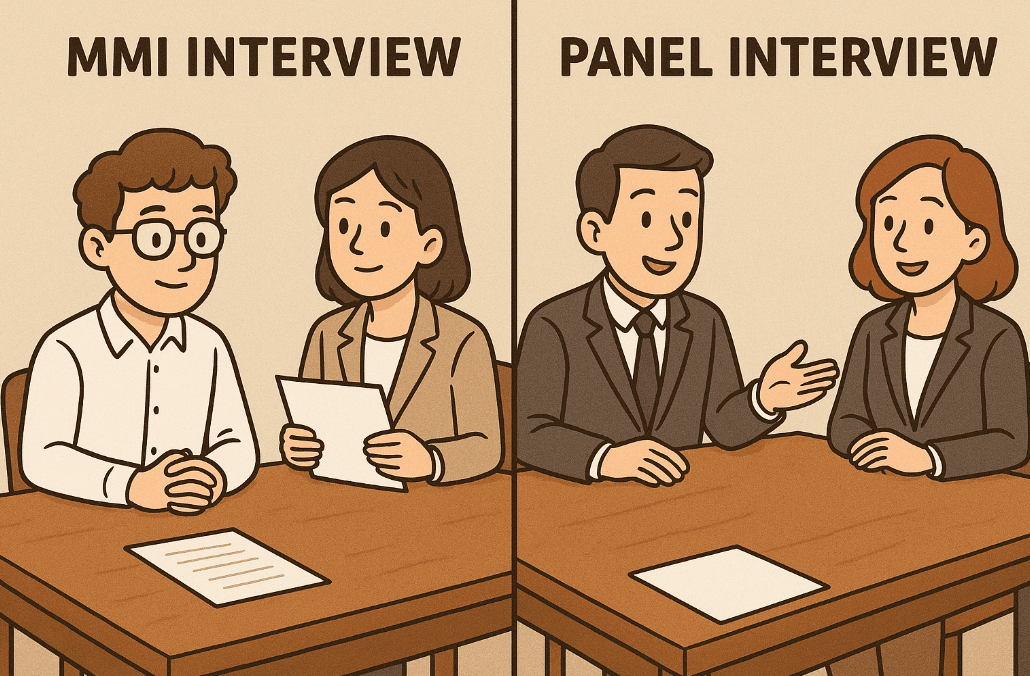
Format #1: MMI (Multiple Mini Interviews)
What it is: 8-10 "stations" set up in a hallway. You rotate through each station. At each station: a new scenario, a new interviewer, 10 minutes total.
The setup:
2 minutes: You read the scenario outside the room
8 minutes: You're in the room responding to the scenario
Then you move to the next station
What they're testing:
Communication
Ethical reasoning
Empathy
Teamwork
Handling conflict
Thinking on your feet
Example stations you might see:
"A patient is refusing a necessary treatment. How do you respond?"
"Your teammate isn't pulling their weight. What do you say?"
"You made a medical error. Walk me through how you'd handle it."
"Defend a controversial healthcare policy."
Role-play: patient interaction, delivering bad news
Schools that use MMI: Stanford, Johns Hopkins, Yale, Duke, UCSF, NYU, Northwestern, Mayo, Washington University, UCLA, and 25+ others.
The vibe: Fast-paced. Awkward at first. Tests how you think under pressure, not how polished you are.
Format #2: Traditional/Panel Interview
What it is: 1-2 interviewers (or a panel of 3-4). Conversational format. 30-45 minutes.
The setup:
They ask you questions
You tell stories
They dig deeper
You discuss your experiences
What they're testing:
Your motivation for medicine
How you think about complex issues
Your personality fit with their school
Leadership potential
Communication under normal (not stressful) conditions
Example questions:
"Tell me about yourself."
"Why medicine?"
"What's your biggest weakness?"
"Tell me about a time you failed and what you learned."
"What would you do if a patient refused your recommended treatment?"
Schools that use traditional: Harvard (sometimes), some DO schools, older/regional schools, some Ivy programs.
The vibe: Conversational. They're trying to get to know you. If you're personable, you'll do well.
Key Differences: Quick Comparison
Aspect | MMI | Traditional |
Length | 10 mins per station (80-100 mins total) | 30-45 minutes |
Number of evaluators | 8-10 different people | 1-2 people |
Type of questions | Scenario-based, ethical dilemmas | Open-ended, personal stories |
Preparation | Practice scenarios, ethics, role-play | Know your story, be authentic |
Pressure level | High (you have to respond immediately) | Medium (conversational) |
What they want | Quick thinking, ethics, communication | Genuine interest in medicine |
Hardest part | Thinking under pressure | Being authentic |
MMI Interview Deep Dive
Station Types You'll See
1. Ethical Dilemma Station
"A colleague is prescribing opioids inappropriately. What do you do?"
They want: Clear thinking, awareness of consequences, balanced perspective
2. Role-Play Station
"You're the doctor. Deliver bad news to this patient."
They want: Empathy, clear communication, composure
3. Teamwork/Conflict Station
"Your team member isn't pulling weight. Respond."
They want: Assertiveness, diplomacy, problem-solving
4. Healthcare Policy Station
"Defend the US healthcare system OR critique it."
They want: Nuanced thinking, not just opinions
5. Knowledge Station (Rare)
Random medical question or case
They want: Humility ("I don't know, but here's how I'd figure it out")
6. Creative/Quirky Station
"If you could be any animal, why?"
They want: You to not take yourself too seriously, creativity
7. Rest Station
Just a bathroom/relaxation space
Breathe, reset, use the bathroom
How to Prep for MMI
1. Understand your position in the room
Station is small (you're right across from interviewer)
They can see your micro-expressions
Fidgeting = nervousness (manage it)
2. Master the 2-minute prep period
Read the scenario 3 times
Underline key words
Jot down your approach
Don't overthink
3. Learn the STOP method
S
cenario: What's actually happening?
T
hink: What are the ethical dimensions?
O
ptions: What could you do?
P
ick: What would you actually do and why?
4. Practice role-plays
Have friends quiz you
Record yourself
Refine your delivery
Work on tone (warm, not robotic)
5. Build your story bank
Leadership example
Failure example
Teamwork example
Ethical dilemma you faced
Why medicine story
Why their school story
Traditional Interview Deep Dive
Question Categories You'll Face
1. The Motivation Questions
"Why do you want to go to medical school?"
"Why medicine vs. other healthcare fields?"
"When did you know medicine was for you?"
How to answer:
Tell a specific story (not generic platitudes)
Show what medicine is actually about (not just "helping people")
Mention their school's values
2. The Personal Questions
"Tell me about yourself."
"What's your biggest weakness?"
"Describe your leadership style."
How to answer:
Be authentic (they can smell BS)
Tell stories > abstract descriptions
Own your weaknesses genuinely
3. The Healthcare Questions
"What's the biggest problem in healthcare?"
"How should we handle healthcare costs?"
"Should doctors have strong personal beliefs affect patient care?"
How to answer:
Show you've thought about it
Multiple perspectives matter
They want nuance, not ideology
4. The Motivation Verification
"Have you shadowed doctors?"
"What did you learn from clinical experience?"
"Why our school specifically?"
How to answer:
Specific examples
What you actually learned
Genuine interest in their program
How to Prep for Traditional
1. Practice the STAR method
S
ituation: Set up context
T
ask: What was the challenge?
A
ction: What did you do?
R
esult: What happened?
Example: "In my clinical shadowing (S), I saw a patient refuse necessary treatment (T). The doctor asked me what I would do (A). I suggested asking open-ended questions to understand the patient's concerns first, then providing information (R). The patient actually agreed after that conversation."
2. Record yourself answering practice questions
Watch it back (it's uncomfortable, do it anyway)
You'll see: filler words ("um"), fidgeting, facial expressions
Refine
3. Know their school inside and out
Mission statement (know it word-for-word)
Interview format
Geographic focus
Any recent news
Specific programs you'd pursue
4. Prepare "why this school" answer
"I'm interested in this school because..." (should be 3-5 minutes of genuine interest)
If you can't answer this authentically, they know
What Schools Are ACTUALLY Testing
Here's the secret: Medical schools already know you're smart. Your MCAT and GPA proved that.
Interviews are about:
Can you think ethically?
(Not just technically)
Will you treat patients with respect?
(Or just diagnose them?)
Can you work on a team?
(Or are you a lone wolf?)
Do you actually want to be here?
(Or just want the status?)
Are you self-aware?
(Do you know your strengths and weaknesses?)
Hybrid Interviews (Mix of Both)
Some schools use both:
Part 1:
MMI stations (morning)
Part 2:
Traditional panel (afternoon)
Example: Duke, Northwestern
How to prep:
Practice both formats
The MMI gets you warmed up (you'll feel less nervous for traditional)
Bring your A-game in the afternoon (you're tired, so rest between)
School-Specific Interview Formats
School | Format |
Stanford | MMI |
Harvard | Traditional & MMI (some years) |
Johns Hopkins | MMI |
Yale | MMI & Traditional |
Duke | MMI + Traditional (hybrid) |
UCSF | MMI |
NYU | MMI & Traditional |
Northwestern | MMI + Traditional (hybrid) |
Mayo | MMI |
Washington University | MMI |
Pro tip: Research YOUR schools. Know their format before you show up.
Red Flags in Interview Prep (Don't Do These)
❌ "I'll memorize perfect answers" → Interview is conversational. Sounding robotic kills you.
❌ "I don't need to prepare, I'm good at talking" → Even talkative people tank if they haven't practiced.
❌ "I'll just be myself" → Being authentic + being polished aren't mutually exclusive. Do both.
❌ "MMI is luck-based, I can't prepare" → False. Prep dramatically improves performance.
❌ "The interviewer wants to reject me" → They want to accept you. They're rooting for you.
Timeline: When to Start Prepping
August (4 weeks before interview):
Learn the format
Do 1-2 practice interviews
Build your story bank
September-October (2-3 weeks before):
2-3 practice interviews per week
Get feedback
Refine weak areas
Week of interview:
One final practice
Rest (don't study, you'll be in your head)
Bring water and snacks
Get good sleep
Common Interview Questions (Prep These)
Personal:
Tell me about yourself
Why medicine?
Why our school?
What's your biggest weakness?
Tell me about a time you failed
Describe your leadership style
What would your friends say about you?
What's something outside medicine you're passionate about?
Ethical: 9. A patient refuses treatment. What do you do? 10. You disagree with a doctor's decision. What now? 11. Tell me about a time you faced an ethical dilemma 12. How do you handle moral disagreement?
Healthcare: 13. What's wrong with the healthcare system? 14. How should we handle [current healthcare issue]? 15. Why do you want to stay in/leave your home state?
Interview Day Checklist
[ ] Print directions (GPS can die)
[ ] Plan to arrive 20 minutes early
[ ] Professional outfit (researched school dress code)
[ ] Comfortable shoes (you might walk a lot)
[ ] Water bottle
[ ] Breath mints (not gum)
[ ] Phone on silent (actually OFF)
[ ] Thank you cards (5-8)
[ ] Notepad and pen
[ ] Calm mind (you've prepared)
After the Interview
Within 24 hours:
Send thank-you emails to each interviewer
Mention something specific about them or your conversation
Keep it brief (3-4 sentences)
Spell their name correctly
What to avoid:
Generic thank-yous (they all get these)
Too many exclamation points
Trying too hard
Example: "Dear Dr. Smith,
Thank you for taking time to interview me yesterday. I particularly enjoyed our discussion about rural healthcare—it reaffirmed my commitment to serving underserved communities. I was impressed by your school's commitment to community medicine.
Best regards, [Your Name]"
Final Tip: Authenticity Wins
The schools that interview you already know you can succeed academically.
What they're really asking is: "Will I enjoy working with you for 4 years?"
Be yourself. Tell true stories. Show genuine interest. That's how you stand out.
Disclaimer
This guide is based on 2025-2026 medical school interview data and trends. Interview formats, questions, and timelines may vary by school and year. Always check individual school websites for their specific interview format and requirements. This content is educational and not official guidance from AAMC or individual medical schools.
Ready to Practice?
Wondering what an actual MMI feels like?
MedReadyGo's interactive MMI simulator puts you in real scenarios with AI feedback. Practice 100+ real station types, get scored, and improve your performance.