MMI vs Panel Interviews: What's the difference?
MMIs and panel interviews can feel intimidating, but understanding their format, purpose, and prep strategies can make all the difference. Here’s your friendly guide to tackle both confidently.
Hey future doctors! 👩⚕️👨⚕️
If you’ve ever applied to med school (or are about to), you’ve probably heard of MMIs and panel interviews, and maybe felt your heart skip a beat just reading those words. Don’t worry, you’re not alone! Today, we’re breaking down these two interview beasts, how they differ, and how you can prepare without losing your sanity.
🌀 What Is an MMI Anyway?
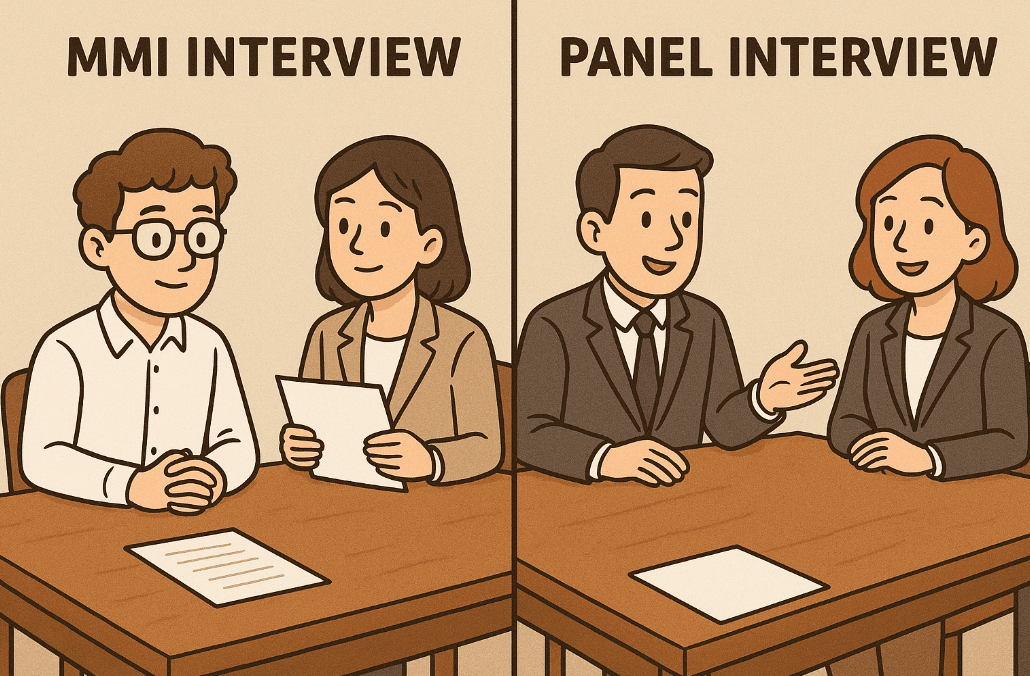
MMI stands for Multiple Mini Interview. Think of it like a speed-dating session, but instead of dating, you’re showing off your brain, personality, and problem-solving skills.
Here’s what to expect:
Usually 6–10 stations, each lasting 5–10 minutes.
Each station has a different task: ethical scenarios, role-plays, teamwork exercises, or even interpreting data.
You rotate through stations quickly, meeting a different interviewer (or actor/assessor) at each one.
Why MMIs exist:
Medical schools want to see how you think on your feet, handle stress, and communicate, not just how well you memorized facts. It’s less about being “right” and more about demonstrating good judgment, empathy, and problem-solving skills.
Pro tips:
Practice thinking out loud. Interviewers love to hear your reasoning, even if you don’t have a “perfect” answer.
Stay calm and treat each station as a fresh start—don’t carry stress from the previous one.
Role-play scenarios with friends to get comfortable with ethical dilemmas and communication tasks.
🪑 What About Panel Interviews?
A panel interview is more traditional. Instead of speed stations, you sit in one room with 2–5 interviewers who ask questions. Think of it as a group interrogation, but in a friendly, professional way.
What to expect:
30–60 minutes with the same group of interviewers.
Questions can range from your motivation for medicine, to current affairs, to hypothetical scenarios.
Sometimes, you’ll get a “mini-presentation” or be asked to reflect on a personal experience.
Why panels exist:
Medical schools want to see depth: how well you articulate your thoughts, handle follow-ups, and maintain professionalism under sustained questioning.
Pro tips:
Make eye contact with all panel members, not just the one asking the question.
Structure answers clearly: Situation → Action → Result (a mini STAR method works wonders).
Don’t be afraid to pause and think—it’s better than rambling.
⚡ Key Differences Between MMI and Panel
Feature | MMI | Panel Interview |
Format | Multiple short stations | Single long session |
Length | 5–10 min per station | 30–60 min total |
Focus | Quick thinking, communication, ethics, teamwork | Depth, reasoning, personal experiences |
Interviewers | Different per station | Same throughout |
Stress factor | High—lots of rotations | Medium—continuous questioning |
Preparation tip | Practice scenarios, role-play, mock stations | Practice structured answers, storytelling, self-reflection |
😂 Funny but True Observations
MMIs feel like being on a game show, except the prize is a medical degree instead of cash.
Panel interviews feel like an intense family dinner, where everyone has questions and you have to impress them all at once.
Both can feel terrifying at first, but once you know what to expect, you can actually have fun showing your personality.
🏆 Final Advice for Both
Practice makes perfect – mock interviews are gold. Ask friends, mentors, or older med students to help.
Know yourself – why medicine? What makes you unique? Prepare 2–3 stories that highlight your strengths.
Stay calm – deep breaths, water, and remembering that interviewers want you to succeed helps.
Be authentic – cheesy answers are obvious. Honesty, empathy, and reflection go a long way.
Reflect – after practice, think about what worked and what didn’t. Tiny improvements make a huge difference.
So, MMI or panel interview, don’t let the names scare you. Think of them as two different ways to show how awesome you are as a future doctor. With the right prep, a few mock runs, and a confident smile, you’ve got this! 😎