MMI Interview Prep: The Complete Guide for UK Y13 Medical Applicants
Master MMI interviews for UK medical school. Learn the format, get ethical frameworks, practice realistic scenarios, and get instant feedback with AI. Complete guide for Y13 applicants.

You've got your interview invitation. The butterflies are real. But here's the truth: the MMI isn't some mystical format you can't prepare for. Thousands of Y13s crack it every year, and with the right prep, you can too.
This guide breaks down everything you need to know about MMI interviews for UK medical schools, from what to expect on the day to exactly how to ace every station. By the end, you'll understand the format, know what examiners are looking for, and have a clear prep plan.
What is an MMI Interview?
MMI stands for "Multiple Mini Interview." It's not the traditional sit-across-from-three-interviewers format. Instead, you rotate through 8-10 short stations, each testing a different skill.
Here's the format:
- 8-10 stations (some medical schools do 6, some do 12)
- 7-10 minutes per station (5-8 minutes with interviewer, 2 minutes prep outside)
- Different scenario at each station (ethical dilemma, communication, teamwork, personal question, etc.)
- Different interviewer at each station (they stay put, you rotate)
- Total time: Usually 2-3 hours with breaks
Key difference from panel interviews: You're not judged on one long interview. Each station is independent. Bomb one station? The next one is a clean slate. This is actually good news for your nerves.
Why UK Medical Schools Use MMIs
UK med schools switched to MMIs because they're fairer and more objective than traditional interviews. Here's why:
Reduces interviewer bias: With multiple short interviews instead of one long chat, admissions teams see you across different scenarios. Your personality quirks don't throw off the entire assessment.
Tests real skills: You can't memorize your way through an MMI. They're testing how you think, communicate, and handle pressure, exactly what you'll need as a doctor.
Assesses non-cognitive qualities: Grades got you the interview. Now they want to see your empathy, problem-solving, ethical reasoning, and ability to stay calm under pressure.
More predictable for candidates: You know the format. You know what to expect. This is actually one of the few parts of medical school applications where you can prepare effectively.
The Types of MMI Stations You'll Face
Not all stations are the same. UK medical schools mix different types to test different skills.
Scenario/Ethical Dilemma Stations
These are the most common. You'll get a prompt like:
"A 16-year-old girl comes to your clinic requesting contraception. She's worried her parents will find out. What do you do?"
You have 2 minutes to read it, then 8 minutes to discuss it with an interviewer.
What they're testing: Your ethical reasoning, communication, ability to see multiple perspectives, empathy.
How to approach: Don't try to be perfect. Show your thinking process. Mention relevant ethical principles (autonomy, beneficence, non-maleficence, justice). Listen to the interviewer's follow-up questions.
Communication Stations (Acting Stations)
You'll speak to an actor playing a patient or family member. Example:
"You're a junior doctor. Break bad news to a patient that their test results show cancer."
What they're testing: Can you communicate clearly? Show empathy? Handle emotional situations?
How to approach: Slow down. Make eye contact. Use frameworks (like SPIKES for breaking bad news). Don't rush.
Teamwork/Collaboration Stations
You might work with another candidate or do a role play.
"You and a colleague disagree on a clinical decision. How do you handle it?"
What they're testing: Can you listen? Adapt? Resolve conflict professionally?
Traditional Interview Questions
Some stations are just straight questions:
"Tell me about a time you failed and what you learned."
These feel familiar if you've done panel interviews before. But remember: you have less time and no small talk cushion.
Current Events/Knowledge Stations
"Tell me about a recent healthcare policy that interests you."
What they're testing: Are you engaged with medicine beyond textbooks?
Note: UK medical schools focus less on this than US schools. But it's worth staying aware of NHS news.
How UK Medical Schools Score MMIs
Examiners use a standardized marking sheet. Usually something like:
- Communication (0-4): Did you express yourself clearly?
- Empathy (0-4): Did you show understanding of the other person's perspective?
- Ethical reasoning (0-4): Did you consider different angles and ethical principles?
- Problem-solving (0-4): Did you think logically and suggest reasonable solutions?
- Professionalism (0-4): Did you stay respectful and composed?
Each station is marked independently. Your final score is the average across all stations.
Important: There's no "perfect answer" to most MMI questions. Examiners aren't looking for one right response. They're looking for your thinking process.
When Will You Get Your MMI Interview? (UK Timeline)
Understanding the timeline helps with prep planning.
- September–October (Y13): You submit your UCAS application
- November–December: Medical schools send interview invitations to shortlisted candidates
- Late November–January: Interview season happens (most interviews before Christmas, some in January)
- January–March: Universities send offers/rejections
What this means: You typically get 2–4 weeks between the interview invitation and the actual interview. That's your prep window.
Most Y13s get interviews in November or December. Some universities interview as late as January.
How to Prepare: Your 4-Week MMI Prep Plan
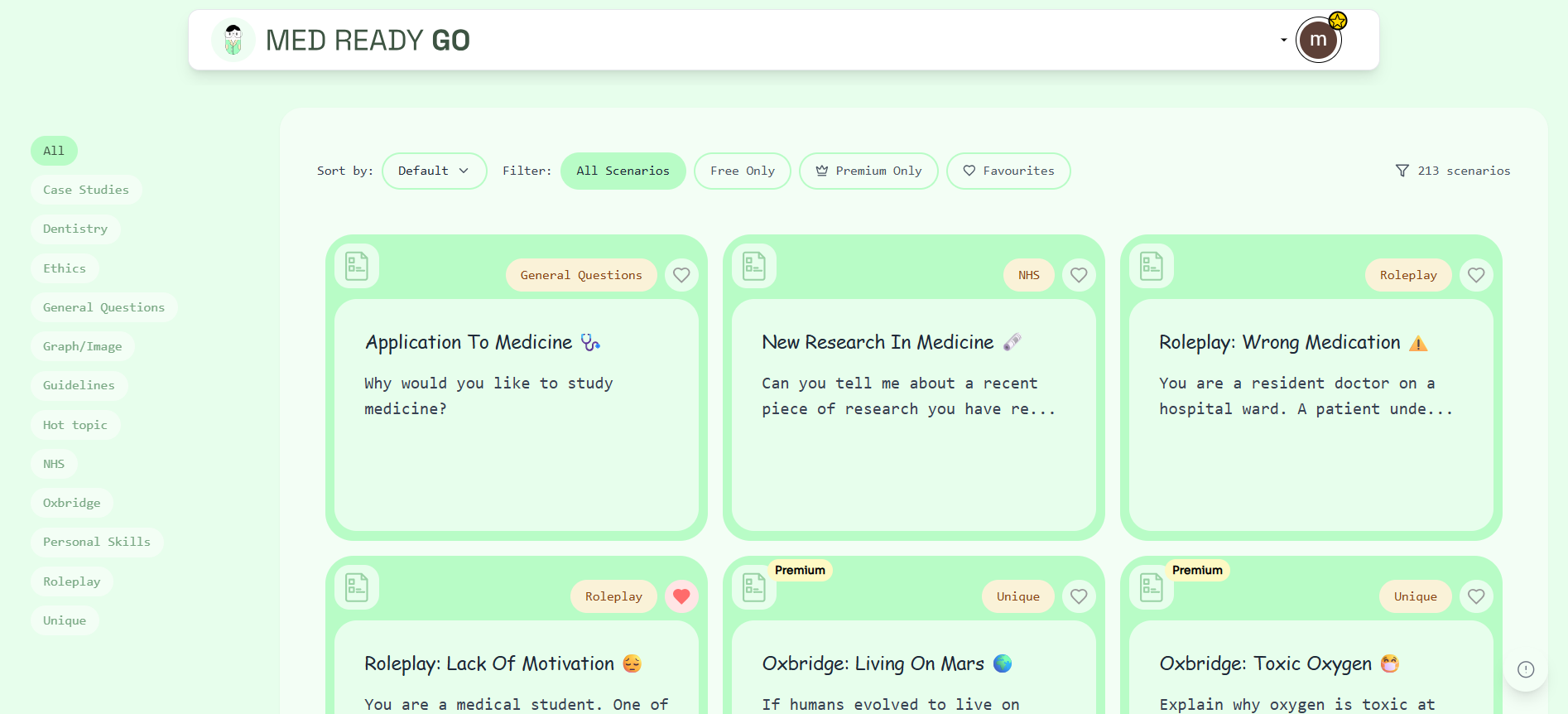
You don't need months of prep. Here's a focused 4-week plan using MedReadyGo's AI-powered practice.
Week 1: Understand the Format + Start Practicing
First, understand what you're dealing with:
- Watch YouTube videos of real MMI stations (search "MMI interview example")
- Read sample MMI scenarios (McMaster University's Interviewer Manual is free)
- Get comfortable with the timing — 2 minutes to read, 8 minutes to answer
Then practice on MedReadyGo:
Do your first 3-5 practice stations on MedReadyGo. Pick different station types, a scenario station, a communication station, maybe an ethical dilemma.
Why: You'll get instant feedback on:
- Communication score (clarity, pacing, confidence)
- Empathy score (did you show understanding?)
- Structure (did your answer make sense?)
- Tone analysis (did you sound rushed or calm?)
This beats recording yourself because MedReadyGo's AI gives you specific, actionable feedback in seconds.
Goal: Complete 5 stations. Average score doesn't matter yet, you're just getting comfortable with the format.
Week 2: Practice Ethical Reasoning
Ethics stations are the most common. Get your framework down.
The 4 ethical principles are your foundation:
1. Autonomy: Respect people's right to make their own choices
2. Beneficence: Act in the patient's best interest
3. Non-maleficence: Do no harm
4. Justice: Treat people fairly
When you get an ethical dilemma in your interview, mention these principles. Show that you're weighing different perspectives.
Practice on MedReadyGo:
Do 10-15 ethical scenario stations. After each one:
- Review your empathy score (this is where ethical reasoning shows)
- Look at the model answer (see how examiners explain ethical thinking)
- Re-record the same station and try to improve your score
Why this works: You're practicing with real UK MMI scenarios, getting feedback, then immediately improving. By the end of week 2, you'll have ethical reasoning wired into your brain.
Goal: Get your empathy score above 7/10 consistently on ethical stations.
Week 3: Build Communication Skills
Practice speaking clearly under time pressure, with an AI that actually responds to you.
On MedReadyGo:
- Pick communication/acting stations (breaking bad news, explaining a diagnosis, etc.)
- Practice 8-10 stations focused on how you communicate, not just what you say
- Each time, work on:
- Speaking slower (MedReadyGo flags rushed speech)
- Pausing to gather thoughts (better than rambling)
- Showing empathy through tone, not just words
- Listening to follow-up questions and actually responding to them
Why AI practice is better than a friend:
- The AI won't get tired of your practice
- It gives consistent feedback every time
- You can practice at 2am if you want
- You get objective scores instead of "yeah, that was good"
Goal: Complete 15-20 stations. Aim for communication scores of 7+/10.
Week 4: Full MMI Circuits + Final Polish
By week 4, you should do full MMI circuits (8-10 stations back-to-back).
On MedReadyGo:
- Do 2-3 full MMI circuits (all stations in one go)
- Don't look at feedback between stations — just push through like real day
- After each circuit, review:
- Which station types struggled with?
- What patterns do you see in feedback?
- Are you getting faster at thinking?
Why circuits matter: Real MMIs are exhausting. Your brain gets tired after 2 hours. Doing circuits builds stamina so you don't crash by station 8.
Then targeted practice:
- Identify your weakest station type
- Do 5-10 more of those specific stations
- Watch your score improve
Goal: Average 7+/10 across a full circuit. Feel confident doing back-to-back stations without falling apart.
Your Weekly Practice Goal
- Week 1: 5 stations
- Week 2: 15 stations (focused on ethics)
- Week 3: 15-20 stations (focused on communication)
- Week 4: 2 full circuits + 10 targeted stations
That's 50-60 total stations of practice in 4 weeks. By interview day, you'll have done this so many times it won't feel scary.
The Biggest MMI Mistakes (And How to Avoid Them)
Mistake 1: Trying to Give the "Perfect" Answer
Many Y13s think there's one right response. There isn't. Examiners care about how you think, not what you think.
Fix: Instead of "I would do X," say "I would consider X because of Y, but I also recognize Z. Here's how I'd balance both."
Mistake 2: Not Listening to Follow-Up Questions
You give your answer. The interviewer asks a follow-up. You ignore it and keep talking.
Fix: Pause. Listen to the follow-up. Actually respond to what they asked, not what you prepared to say.
Mistake 3: Rambling or Staying Silent
Some students talk in circles for 8 minutes. Others freeze and say nothing.
Fix: Plan your answer in those 2 minutes of prep. Start with your main point. If you run out of things to say in 3-4 minutes, that's fine. The interviewer will ask follow-ups.
Mistake 4: Forgetting to Show Empathy
Even in non-scenario stations, empathy matters. "I failed chemistry because I didn't study" sounds lazy. "I failed chemistry because I underestimated the subject, and I felt disappointed in myself" shows self-awareness and maturity.
Fix: When telling a story, include how you (or others) felt, not just what happened.
Mistake 5: Panicking if You Don't Know the Answer
You get a question about a healthcare policy you've never heard of. You freeze.
Fix: Be honest. "I'm not familiar with that specific policy, but I'd approach it by..." then show your thinking process instead.
What Examiners Actually Want to See
Forget the myths. Here's what UK medical school interviewers are actually looking for:
✅ Clarity: Can you explain your thinking in plain English?
✅ Self-awareness: Do you know your strengths and weaknesses?
✅ Empathy: Do you genuinely care about other people's perspectives?
✅ Resilience: Can you handle a tough question without falling apart?
✅ Authenticity: Are you being yourself or performing a character?
✅ Problem-solving: Can you think logically through a scenario?
❌ Perfection: They don't expect flawless answers
❌ Medical knowledge: They're not quizzing you on facts
❌ Confidence bluffing: Pretending to know something you don't
❌ Rehearsed speeches: Sounding robotic or over-prepared
❌ Dismissing others: Shutting down other perspectives
Why MedReadyGo Makes MMI Prep Easier
Here's the reality: reading about MMI prep is different from doing it. You need real practice with feedback.
That's why AI practice is game-changing for MMI prep.
With MedReadyGo, you:
- Practice realistic scenarios: Our scenarios are based on actual MMI questions from UK medical schools
- Get instant feedback: After each practice, you see scores for communication, empathy, ethical reasoning, and more
- Practice unlimited times: Improve your score, re-record, see yourself improve
- Save time: No need to find friends willing to be your mock interviewer every night
- Build confidence: By interview day, you've done this 50+ times. It won't feel scary anymore
Practice is the only way to get better at MMIs. MedReadyGo makes unlimited practice actually possible.
Final Thoughts
The MMI isn't luck. It's not magic. It's a skill you can develop with practice.
The Y13s who ace MMIs aren't smarter than you. They're not "naturally good at interviews." They've just practiced more. They know what to expect. They're comfortable with the format.
You can be that person too.
Start with one practice station. Then another. Build the skill over 4 weeks. By interview day, you'll walk in knowing exactly what to do.
And remember: this interview is your chance to show who you really are. Not who you think they want you to be. The best MMI performances come from Y13s being authentic, thoughtful, and genuine.
You've got this.
---
Ready to practice? Start your first MMI station on MedReadyGo and get instant feedback on your communication, empathy, and ethical reasoning.