How to Build Your Medical School List: Reach, Target, Safety Schools (2026-2027)
Step-by-step guide to building your medical school list. Includes MCAT/GPA benchmarks, location considerations, and the reach/target/safety formula.
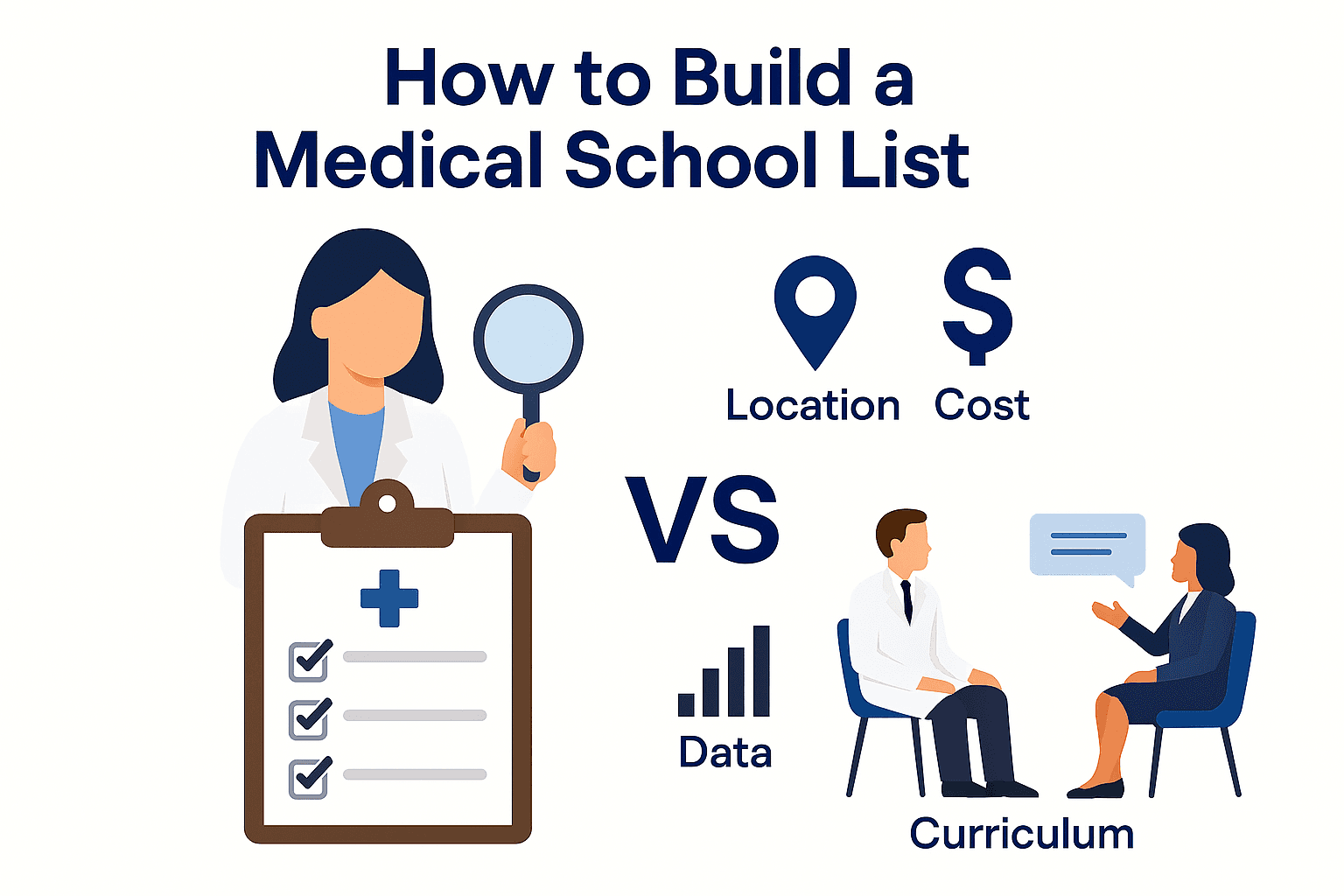
How to Build Your Medical School List: Reach, Target, Safety Schools (2026-2027)
Reading time: 11 minutes
Building a school list without a strategy is how you end up applying to 50 schools or missing your dream school.
You need a framework.
Here's the exact method used by successful applicants—the ones who get multiple acceptances, not just one desperate acceptance in April.
The Framework: Reach, Target, Safety
Think of medical schools in three tiers:
REACH SCHOOLS (10-20% chance)
Your stats are below their averages
You're betting on other parts of your application
But it's possible to get in
TARGET SCHOOLS (40-60% chance)
Your stats are in their range
You're competitive
These are your realistic acceptances
SAFETY SCHOOLS (70%+ chance)
Your stats are above their averages
You're very likely to get in
These exist (many don't realize this)
Step 1: Calculate Your Stats Profile
First, know YOUR numbers.
Your MCAT Score:
Take a full-length practice test (AAMC if possible)
This is your predicted score
If you haven't taken MCAT yet: use your FL average
Your GPA:
Science GPA (biology, chemistry, physics, biochemistry)
Overall GPA
(Medical schools care about both)
Your Shadowing/Clinical Hours:
ER shadowing
Clinical rotations
Research hours
Volunteering hours
Your Experiences:
Leadership positions
Research publications?
Unique background?
Disadvantaged background?
Write this down. You'll use it repeatedly.
Step 2: Understand School Statistics
Every school publishes:
MCAT range
(25th-75th percentile)
GPA range
(25th-75th percentile)
Acceptance rate
Class size
Interview format
For example:
Harvard: 509-528 MCAT, 3.73-3.98 GPA, 3.2% acceptance
Yale: 513-527 MCAT, 3.77-3.97 GPA, 3.3% acceptance
Michigan: 509-523 MCAT, 3.70-3.96 GPA, 6.5% acceptance
Key insight: Just because you score at their 50th percentile doesn't mean 50% of applicants get in. Other factors matter (experiences, background, fit).
Step 3: Create Your Reach Schools (10-15% acceptance rate)
Selection criteria:
Your MCAT is 2-5 points below 25th percentile
Your GPA is comparable to theirs
You have a compelling "why" for this school
You genuinely want to go there
Examples (for someone with 515 MCAT, 3.85 GPA):
Stanford (1% acceptance, but strong research → reach)
Johns Hopkins (3% acceptance)
Columbia (3% acceptance)
Mayo (2% acceptance)
How many reach schools? 2-4 total. Don't apply to 10 reaches—that's a waste of application fees and essays.
The reach school mindset: You're betting on your experiences, personal statement, and interview. Your stats alone won't get you in. But they're not disqualifying.
Step 4: Create Your Target Schools (35-60% acceptance rate)
Selection criteria:
Your MCAT is at their 25th-75th percentile
Your GPA is at their 25th-75th percentile
You're genuinely interested in them
They offer programs you care about
How to find target schools:
Go to AAMC MSAR (Medical School Admission Requirements)
Filter by your MCAT score
Look for schools where you're at/above 25th percentile
Add schools with 30-60% acceptance rate
Examples (for someone with 520 MCAT, 3.70 GPA):
University of Michigan (6.5% acceptance, but in-state helps)
Boston University (4% acceptance)
Emory (3.5% acceptance)
UCSF (2.5% acceptance)
University of Washington (3% acceptance, especially if Pacific Northwest interest)
How many target schools? 8-12 total. This is where your acceptances come from.
Step 5: Create Your Safety Schools (60%+ acceptance rate)
This is where most applicants fail. They don't have true safety schools.
Selection criteria:
Your MCAT is at/above 75th percentile
Your GPA is at/above 75th percentile
You're interested (not just applying to be safe)
They have good outcomes
Examples (for someone with 520 MCAT, 3.70 GPA):
University of Nevada, Reno (13% acceptance)
University of South Carolina (10% acceptance)
Texas Tech (12% acceptance)
Marshall University (14% acceptance)
East Carolina University (11% acceptance)
How many safety schools? 3-5 total. You should feel confident about at least 2-3 of these.
Pro tip: In-state schools are safer. If your stats are good for a school, in-state status adds 20-30% to your acceptance likelihood.
Step 6: Add Location & Mission Filters
Now filter your list by:
Geographic Preference
Do you want to stay in your region?
Are you willing to move?
Do schools feed into good residencies nearby?
Strategy: If you're strong, apply national. If you're average stats, apply in-state + nearby region.
Mission Alignment
Rural medicine focus? → Look for rural-focused schools
Primary care? → Look for primary care-focused schools
Research? → Look for research-heavy institutions
Social justice? → Look for schools with mission-driven focus
Example:
Want to serve rural patients? → University of North Dakota, University of Washington
Want research? → Stanford, UCSF, Johns Hopkins
Want primary care? → University of Colorado, University of Iowa
Want diverse population served? → Howard, Meharry, UCSD (historically serve many underserved)
Step 7: Verify School Details
Before finalizing, check:
When will interview season be? (Complete AMCAS Application Timeline)
Interview format (MMI vs Traditional)
Class size (want smaller or larger?)
Curriculum (traditional vs problem-based?)
Board scores (do they perform well on Step 1/2?)
Research opportunities
Residency placement (where do graduates go?)
Cost (some schools are much cheaper)
Atmosphere (competitive vs collaborative?)
Research resources:
School website (duh)
Reddit (r/medicalschool honest takes)
Student review sites
Virtual interview day videos
Alumni reviews
The Complete School List Example
Profile: 520 MCAT, 3.70 GPA, Strong clinical experience, interested in rural medicine
Reach Schools (3)
Stanford (1% acceptance, but unique experiences)
Johns Hopkins (3% acceptance, interested in their rural track)
Oregon Health & Science University (4% acceptance, Oregon preference)
Target Schools (10)
University of Michigan
Boston University
Emory
UCSF
University of Washington
University of Colorado
University of Iowa
University of Minnesota
Wake Forest
Indiana University
Safety Schools (3)
University of Nevada, Reno
Texas Tech
University of South Carolina
Total: 16 schools Total cost: ~$5,000 in application fees (expensive, but necessary)
Common School List Mistakes
❌ Mistake 1: All reaches
Applying to 10 T10 schools
Result: Rejected everywhere
Fix: Only 2-4 reaches
❌ Mistake 2: No safeties
"I don't need safety schools, I'm smart"
Result: One acceptance in April (scrambling)
Fix: 3-5 genuine safeties
❌ Mistake 3: Random schools
"I'll just apply to as many as possible"
Result: Generic essays, wasted money
Fix: Targeted list with 15-17 schools
❌ Mistake 4: All in-state only
"I can only go to my home state"
Result: Limited options
Fix: Regional + 2-3 distant targets
❌ Mistake 5: Ignoring mission fit
"Any medical school is fine"
Result: Interviews ask "Why do you want to be here?" and you have no answer
Fix: Research each school's values
The Numbers Behind Acceptance
Reality check:
Average applicant applies to 15-17 schools
Average applicant gets 1-3 interviews
Average applicant gets 1 acceptance
Excellent applicant (top 10% stats) gets 5+ acceptances
This means:
You NEED a solid target school tier
You NEED safeties
Your stats alone don't determine your outcome
Special Considerations
If You're Applying to Texas (TMDSAS)
TX schools are separate application system
They're cheaper but fill up fast
Should apply to 3-5 TX schools if interested
If You're International
Very few schools accept internationals
Apply to: NYU, Case Western, Georgetown, Mayo, Howard, UAB
Much more competitive
If You Have Strong Research
You can apply "up" (higher-ranked schools)
Research is huge for T10 schools
Use this to your advantage
If You're Disadvantaged/URM
Many schools have missions to recruit URMs
You might get "boost" in admissions
But don't apply only to schools with your stat profiles hoping for boost
Still build a balanced list
If You're Older/Career Changer
Some schools prefer traditional students, some prefer diverse ages
Research school cultures
Emphasize what your age/experience brings
Using Admit.org
Many students use Admit.org's school list builder:
Pro:
Tracks your chances
Suggests schools
Updates as data changes
Con:
Can be overly optimistic
Still need personal research
Don't blindly follow its classifications
Use it as a guide, not gospel.
Excel Spreadsheet Template
Create a spreadsheet tracking:
School | MCAT 25/75 | GPA 25/75 | Accept Rate | Your Tier | Interview Type | Location | Cost | Status |
Stanford | 509/528 | 3.73/3.98 | 1% | Reach | MMI | CA | $85 | Pending |
(This helps you see the full picture)
Timeline: When to Finalize
January 2026:
Start researching (broad strokes)
March 2026:
Narrow to 20-25 schools
May 2026:
Finalized 15-17 schools (by the time you submit)
June 2026:
You're locked in (don't keep adding schools)
The Reality of School Selection
Here's what schools won't tell you: they care more about you than your stats.
If your personal statement is compelling and you interview well, a school will take you. If your personal statement sucks and you interview poorly, even a T10 school might reject you.
So:
Build a balanced list (reach/target/safety)
Write strong essays tailored to each school
Practice interviews obsessively
Let the list be your safety net, not your whole strategy
Researching Schools: Key Questions to Answer
For each school on your list, know:
About the school:
What's their mission statement?
What's unique about their curriculum?
Do they have specific programs (rural track, research track)?
What's their culture like?
About outcomes:
Where do graduates end up for residency?
How well do they perform on board exams?
What specialties are they strong in?
About location:
What's the city/region like?
What hospitals will you rotate at?
Are there research opportunities?
Cost of living?
About fit:
Does their mission align with yours?
Do they value what you value?
Can you see yourself there?
Red Flag Schools (Be Careful)
Some schools to be cautious about (not bad schools, just do your research):
Recently established schools (less data on outcomes)
Schools with low board exam pass rates
Schools in very expensive cities (high debt)
Schools with poor residency placement
This doesn't mean avoid them, just be aware.
Disclaimer
This guide is based on 2025-2026 medical school data and general trends. Medical school statistics, acceptance rates, and interview formats change annually. Always verify current data directly from:
AAMC Medical School Admission Requirements (MSAR)
Individual school websites
Current medical school applicant databases
This content is educational and not official guidance from AAMC or individual medical schools. Your personal circumstances (background, location, experiences, etc.) may affect your school list strategy significantly. Consider consulting with pre-med advisors or professional admissions consultants for personalized guidance.
Next Steps
Gather your current stats
(MCAT FL scores, GPA)
Go to AAMC MSAR
and start filtering schools
Create a spreadsheet
tracking your schools
Research 2-3 target schools
in detail this week
Join r/medicalschool
and read honest school reviews
Ready to Prepare for Your Interviews?
Once you've submitted your applications and interviews start rolling in—that's where MedReadyGo comes in.
Our interview prep platform helps you research schools deeply and practice articulating your genuine fit. Strong school fit = stronger essays = more interviews.